
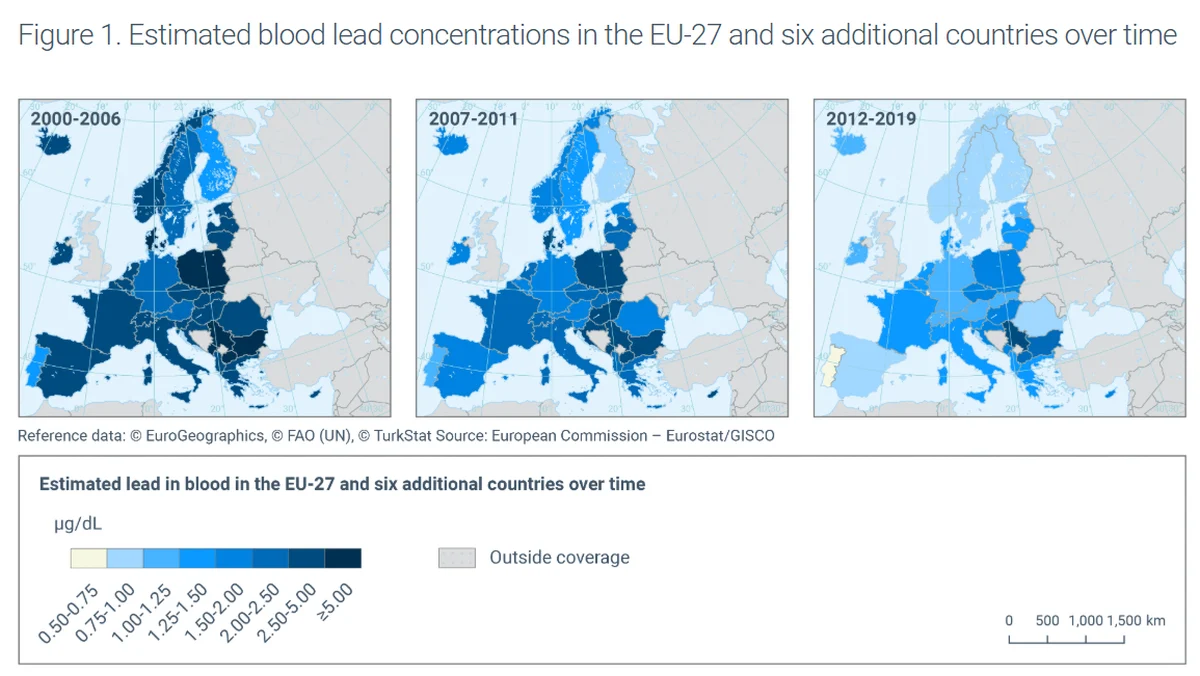
The European Environment Agency (EEA) published new data in November 2026 on lead exposure in Europe. Among the sources it mentions: old pipes that carry drinking water.
What the news says
- Average blood lead levels in Europe fell by about 60% between 2000-2006 and 2012-2019.
- Even so, lead exposure still causes more than 62,000 premature deaths a year (conservative estimate).
- The EEA states that old lead-containing pipes can contaminate drinking water.
- Mortality linked to lead is higher in Bulgaria, Croatia, Hungary, Romania and parts of the Baltic region.
Why it matters for the water you drink
The water may leave the treatment plant in perfect condition and still pick up lead on its way through the last metres of old pipes in a building. That is why quality at the source does not always mean quality in the glass.
Where AguaPARS fits in
An AguaPARS generator produces water inside the machine itself, a few centimetres from the tap. It does not travel through old building pipes, so that route of contamination does not apply.
How AguaPARS water is made, and its limits
AguaPARS generators make drinking water by condensing the humidity of the air. The air first passes through a HEPA filter and an activated-carbon filter; the water is kept in contact with UV light and goes through physical, mineral and carbon filtration before it reaches the tap. The analyses of the water generated by AguaPARS, carried out in accredited laboratories in Spain, found no microplastics or chemical contaminants; you can see the reports on our technology page. Limits: the machines need at least 25 % relative humidity and 15 °C, they use electricity (0.24 to 0.42 kWh per litre depending on the model) and they are designed for drinking water, not for irrigation.
Want to know which model fits your home or business? See all models, try the water calculator or contact us.
Source
Source: European Environment Agency, 12 November 2026.
This article summarises facts reported by the source above. AguaPARS has not verified them independently. Figures and dates are those of the source.
