01What is AguaPARS?
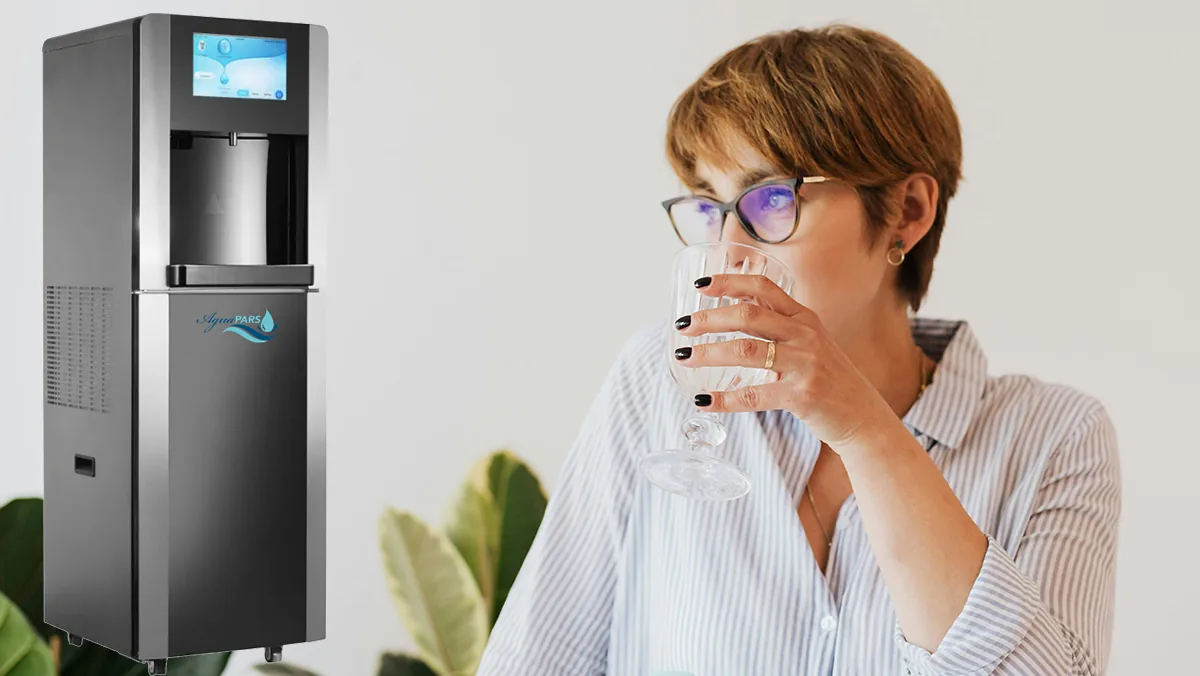
AguaPARS is an atmospheric water generator.
02What is an atmospheric water generator?
AguaPARS atmospheric water generators are devices that extract moisture from the surrounding air through condensation and turn it into high-quality drinking water.
03What is condensation?
Condensation is the process by which water vapour turns into liquid. It is the reverse of evaporation, in which liquid water turns into vapour. Condensation happens in one of two ways: either the air cools down to its dew point, or it becomes so saturated with water vapour that it cannot hold any more water.
04How do AguaPARS generators use condensation technology to produce water?
AguaPARS atmospheric generators cool the air down to its dew point to create water.
05So does this mean the AguaPARS generator doesn't need to be connected to the water mains to get water from it?
That's right. It requires no infrastructure or pipes. All it needs to produce water is air and electricity.
06Where can I put my AguaPARS generator?
Since AguaPARS generators don't need to be connected to water pipes, you're free to choose where to put them. We suggest installing the device in a well-ventilated area. We don't recommend placing home or office units in a closed, windowless room. These generators can also be placed outside the house, as long as they are protected from the rain.
07What is the difference between AguaPARS generators and water purification systems such as reverse osmosis?
All water purification systems, such as reverse osmosis or any kind of water softener, first need a source of water. These systems use a lot of energy, and large volumes of water are wasted during the process. What's more, the water isn't 100 % clean because it contains chlorine, and a certain level of nitrates and other contaminants always remains in the water.
08What do AguaPARS water generators need to work?
AguaPARS generators need a minimum temperature of 15 °C and a minimum humidity level of 25 % to produce water. In ideal conditions, at a temperature of around 30 °C and a humidity level of 80 %, these generators reach their peak efficiency. In fact, the closer we are to ideal conditions, the faster and more abundant the water production will be.
09How many categories are AguaPARS generators divided into?
AguaPARS generators are divided into two categories: the first is home and office generators, which are used to fill glasses and containers and have dispensers. The second category, industrial generators, produces large volumes of water and is used to fill water tanks and replace the water supply of a home.
10What is the daily production capacity of AguaPARS generators?
The maximum water production capacity of AguaPARS home generators with dispensers ranges from 20 litres to 500 litres per day, while that of AguaPARS industrial generators ranges from 100 to 1,000 litres per day.
11If needed, how can capacities above 1,000 litres per day be supplied?
You can easily connect several industrial generators and use them to fill water reservoirs.
12Why isn't a water generator above 1,000 litres available in the AguaPARS catalogue?
Because generators above 1,000 litres a day are harder to transport and install, and their large size would require a dedicated space. At the same time, splitting high capacities across several smaller generators makes them easier to transport and position on site.
13What is the power consumption of AguaPARS generators?
The heat exchange technology in AguaPARS generators is designed and built with low energy consumption in mind. For example, a generator able to produce 20 litres of high-quality drinking water per day has a maximum power of 350 W (only while it is generating water).
14How much will each litre of drinking water from AguaPARS generators cost?
At current electricity prices in Spain in 2024, and assuming an average of 15 cents per kilowatt, each litre of water will cost between 2 and 3 cents.
15How do AguaPARS generators work?
Put simply:
First, ambient air is drawn into the generator by a powerful intake system and passes through two filters that make sure the incoming air is completely clean: first a HEPA filter, which captures all suspended particles and dust down to 2.5 microns, and then an activated carbon filter to remove any odours from the air.
Next, the air enters the AguaPARS heat exchanger system. The key feature of this heat exchanger is that air enters the system rapidly, in a very short time, which ensures greater efficiency and the lowest possible energy consumption to extract water from the air. The dry air leaves from the other side of the generator.
The water produced by the heat exchanger is stored in an internal tank and circulates continuously. A UV lamp close to this tank prevents all kinds of microbes, bacteria and microorganisms from forming and growing, so the water produced always stays clean and fresh.
Before leaving the water tank for drinking, the water passes through three filters: the first is a molecular-level physical filter to ensure maximum purity; the second is a mineral filter that adds the minerals the body needs; and the third is an activated carbon filter that removes any unpleasant taste from the water.
The result: our generators produce drinking water of the highest possible quality.
16Why does AguaPARS claim to produce drinking water of the highest quality?
In all water purification systems, the water entering the system is contaminated, mixed with many salts, toxic and chemical substances and/or heavy metals; then, after passing through several stages, this contamination is removed to a certain extent and the water becomes drinkable. AguaPARS generators produce pure water, free of salts and toxic substances, and they are completely hygienic. That's why, as you can see from the water test results on the AguaPARS website, our water can rank among the highest-quality water in the world.
17How do AguaPARS generators help the environment?
Using a water generator means we have the potential to eliminate plastic bottles from the transport chain and reduce fuel consumption.
18What other advantages do AguaPARS generators offer?
By creating your own water source, you'll always have fresh, clean and healthy drinking water available, right where you need it. A unique and innovative technology, an advanced, efficient and economical condensation system with low power consumption and compatible with renewable energy, together with UV-lamp purification systems and low-temperature water circulation. AguaPARS generators guarantee great taste and no added chemicals such as chlorine. Simply plug in the generator, wait for it to produce water, then drink it. It requires no infrastructure or pipes. All it needs to produce water is air and electricity.
19Why is the water produced by AguaPARS generators even healthier than bottled water?
The results of a study carried out in France show that most bottles of mineral water contain microplastics. In this study, the “Action for the Environment” institute examined and analysed bottles of mineral water from several factories in a specialised laboratory. According to its findings, at least 7 out of 9 bottles of mineral water contain tiny plastic particles suspended in the water.
These particles are usually smaller than 5 mm and there are usually few of them, but the number varies in water produced at different factories. Ingesting large amounts of microplastics can have potentially harmful effects, such as cell death and allergic reactions. Thanks to their powerful filtration systems, AguaPARS generators keep your drinking water free of microplastics.
20Does the water produced by AguaPARS generators have a particular taste?
We make sure the water from our generators is as delicious as possible. Water extracted from the air is generally “lighter” than tap water. In addition, the mineralisation process adds calcium and magnesium to improve mouthfeel and taste.
21Can I switch off my AguaPARS generator?
No. Once you plug in the generator, you shouldn't switch it off. The advanced system in AguaPARS generators controls the entire production process, starting it when the tank empties and stopping it when the tank is full. When production stops, power consumption drops by 95 %, but the water keeps circulating in the tank and its hygiene is maintained by UV lamps. If for any reason you have to switch the generator off for a long time, you should discard the water in its tank.
22Do AguaPARS generators also filter the surrounding air?
Air purification is part of the water production process, which is especially useful in cities with high levels of air pollution.
23Can the output water be chilled or heated?
Yes. A water heater or chiller can be added to the generator on request. In addition, some AguaPARS generator models come fitted as standard with a water chiller, a heater or both.
24Do AguaPARS generators come with a water storage tank? What happens when the tank is full?
Every AguaPARS generator has an internal tank that fills gradually as water is produced. When the water level reaches the maximum limit, the generator stops production, but the water keeps circulating in the tank and the UV lamp keeps it fresh and healthy. At that point, power consumption drops by 95 %. When the water level in the tank falls, production resumes.
25How long does it take for the water tank to fill and be ready to use after connecting the AguaPARS generator to the power supply and switching it on?
It all depends on the ambient humidity and temperature and, of course, on the volume of the generator's tank and its production capacity. Ideal conditions are 80 % humidity and an ambient temperature of around 30 °C. In these conditions, the generator reaches its maximum efficiency and can produce water at its rated capacity over 24 hours. For example, a generator with a capacity of 50 litres of water per day can produce 50 litres of drinking water in 24 hours at a temperature of around 30 °C and an ambient air humidity of about 80 %, which is roughly 2 litres per hour.
26What are AguaPARS generators used for? Where and for what purposes can they be used?
They can be placed in homes, offices, schools and colleges, retail shops, hospitals, government offices, industrial plants, ships, farms and stables, agriculture, horticulture and greenhouses, military bases, NGO shelters, and as relief after natural disasters such as earthquakes or floods.
27How do I choose the generator I need?
First, you need to know whether you want to use the water directly for drinking, that is, to fill glasses straight from the unit, or whether you plan to fill water tanks. If you plan to drink the water directly, you should choose one of the home or office models; if you plan to fill water tanks, you should choose one of the industrial models.
Next, you need to know and calculate your water consumption. For example, do you only need water for drinking? Or for cooking as well? Or do you need water for bathing and washing? Perhaps you need water for irrigation and farming? In each of these cases, the daily volume will be different.
Once you know how much you need, visit the AguaPARS website and, following our recommendation, choose a generator one step above your daily water requirement.
For example, if you need ten litres of water a day, choose a 20-litre generator. Why? Because you can't have ideal ambient conditions 365 days a year for your generator to produce at full capacity. So if you have a higher-capacity generator, you'll get the full amount of water you need even in less-than-ideal conditions.
28What does servicing and maintenance of AguaPARS generators involve?
The only maintenance required is changing the filters, which the end user can easily do. We also offer our after-sales service and a 2-year warranty.
29When should the filters in AguaPARS generators be replaced?
You can see when the filter needs replacing on the generator's display. However, we estimate that, if the generator is used at full capacity, the filters should last about a year.
30What warranty do AguaPARS generators come with?
AguaPARS generators come with a two-year warranty from the date of purchase.
31What is the advantage of producing water from air humidity?
Water produced from air humidity is distilled water. It is therefore nothing like water from other sources and is very clean. It contains no toxic substances, chemicals, harmful substances or heavy metals. You can even drink it directly in the short term. On the other hand, humidity is increasingly accessible, so water can be produced in more places and more and more people can have their own water source.
32Is producing water from the air safe and healthy?
Air is a cleaner resource than the ground. Producing water from the air removes the need to pump groundwater and the worry of soil contamination. In addition, the water generated by AguaPARS systems goes through a rigorous filtration process that removes the dust and particles remaining in the air.
33What is drinking water and what characteristics should it have?
Drinking water is water of suitable quality that can be drunk with no negative effects in the short or long term. It is treated after being extracted from water sources, and the salts and substances it contains are monitored. To be drunk in the short and long term, water must be completely clear and colourless, and its mineral salt content must be below 5 grams per litre. Excess minerals such as calcium, magnesium, iron and copper can, in the long term, lead to conditions such as kidney stones and cardiovascular disease. Water must not contain toxic substances or have an unpleasant smell. It must pass microbiological tests and meet official standardised levels.
34What percentage of people on the planet have no access to drinking water?
Currently, 30 % of people in the world have no access to drinking water; that is, around 3,000 million people get their drinking water from improved and/or bottled water sources, which may require a trip of at least 30 minutes to reach. Or they use unprotected wells and springs, or collect unfiltered surface water from lakes, wetlands, rivers and streams, which can be very unhealthy and dangerous. According to research by major global institutions, it is believed that over the next decade 50 % of the world's population will live in areas without access to clean, fresh and healthy drinking water. Some people have gone even further and believe that future wars will be fought over water resources.
35How real is the problem of global drought, and to what extent does it threaten humanity?
The problem of global drought is very real and growing. In the latest edition of the UN World Water Development Report, UNESCO and UN-Water warn that, unless international cooperation in this field is strengthened, these shortages will worsen in the coming decades, especially in cities. Globally, 2,000 million people (26 % of the population) have no access to safe drinking water and 3,600 million people (46 %) lack access to safely managed sanitation. According to the report published by UNESCO on behalf of UN-Water, between 2,000 and 3,000 million people face water shortages for at least one month a year, posing serious risks to their livelihoods, particularly food security and access to electricity. The global urban population facing water scarcity is expected to double, from 930 million in 2016 to between 1,700 and 2,400 million in 2050. The increasing frequency of severe and prolonged droughts is also putting pressure on ecosystems, with serious consequences for plant and animal species.
36What is the impact of global warming and climate change on the world's water resources?
Over the last 100 years, the Earth has warmed abnormally, which worries scientists. Climate change and rising global warming have caused droughts to spread, and this change also makes rainfall distribution uneven and affects water resources. Higher temperatures, and therefore more evaporation and transpiration, together with lower rainfall will intensify desertification and soil salinisation. Furthermore, climate change can make weather patterns hard or even impossible to predict, and this uncertainty makes it difficult to sustain crops in areas that depend on agriculture.
In short, every year the Earth will be hotter than the year before, droughts will spread further each year and water resources will become more limited.
37What are the sources of water supply?
Sources of drinking water include surface water, groundwater and salt water. Surface water includes water from rivers, lakes, wetlands and natural storage reservoirs. Groundwater, found in aquifers (water tables), is accessed by drilling wells, building channels and using water pumping equipment. The volume of both is decreasing in many regions of the world, and they are no longer fit to drink directly. A full cycle of microbial and physical purification of salts and toxins, and monitoring of them, is therefore required. The third source is the salt water of oceans and seas, which cannot be consumed because of its high salt content; it must be treated using advanced desalination processes, which use a great deal of energy.
38Is there another source of drinking water that is inexhaustible?
Yes. Producing drinking water from air humidity. Humidity is found all over the planet. More than 80 % of the planet's land surface has humidity levels above 50 %. It is also an endless source, because every year, as the planet's temperature rises, the amount of water evaporating from the seas and oceans increases, and so does the humidity level of the air. In this sense, AguaPARS generators can help people create their own water source: fresh, clean and healthy drinking water that is always available, right where they need it.
39Who manufactures AguaPARS generators?
PARS EcoTech S.L., based in Málaga (Spain), is the manufacturer of AguaPARS generators.
40How can we order AguaPARS generators?
To place an order, please visit our contact page.