
Getting drinking water out of the air sounds like science fiction, but it is based on something you see every summer: the droplets that appear on a glass of cold water. An atmospheric water generator does the same thing, but in a controlled, clean and continuous way. Here is, without technical jargon, what happens inside the machine.
There is water in the air
The air we breathe always contains water vapour, even if we cannot see it. The amount depends on temperature and humidity: warm air can carry far more water than cold air. When that air is cooled enough, the vapour turns into droplets. This is condensation, the same phenomenon that forms morning dew or mists up a mirror after a shower.
An atmospheric water generator uses this simple physics: it cools the air in a controlled way to collect its moisture and turn it into drinking water.
The process, step by step
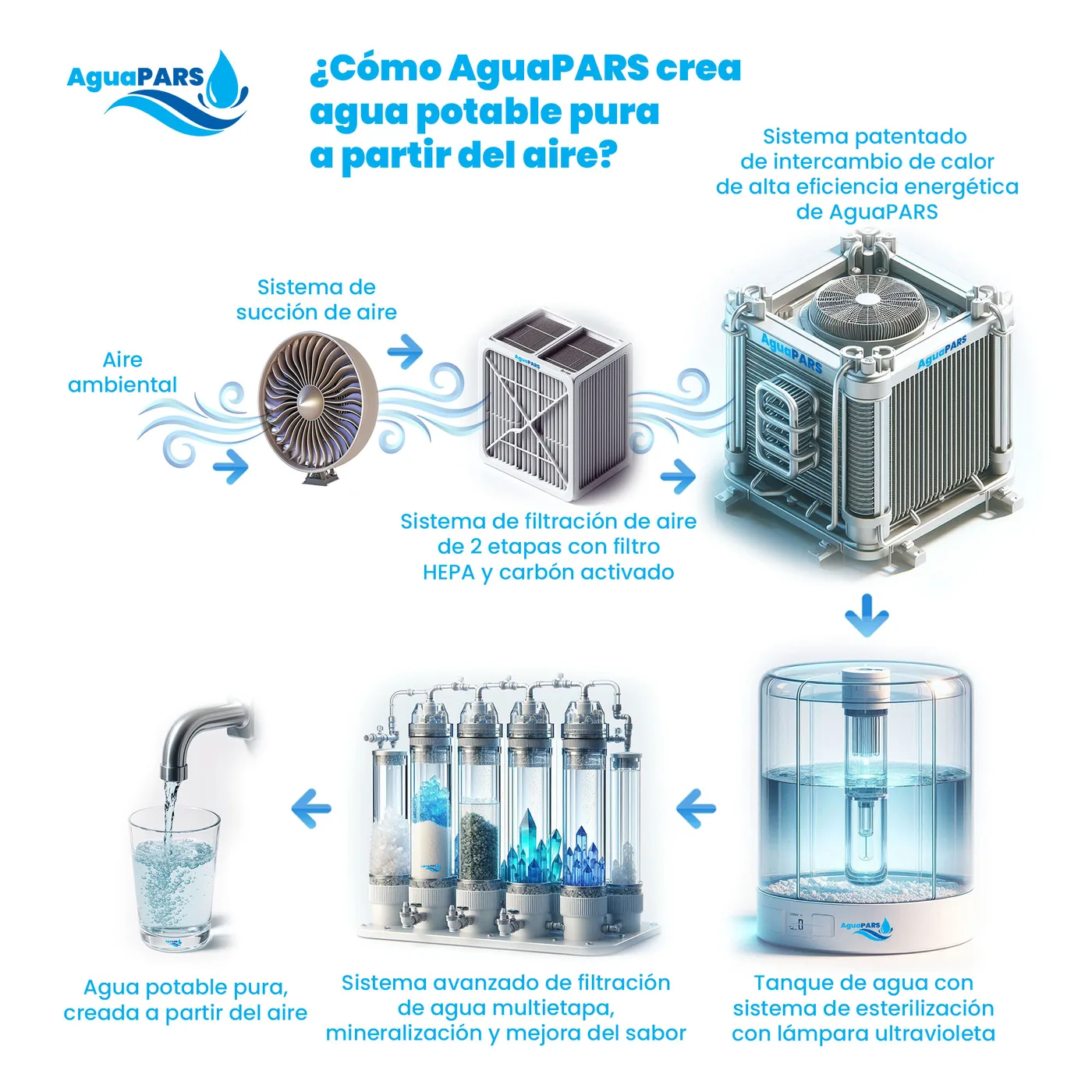
- Air intake. A fan draws in air from the room or from outside.
- Air filtration. First of all, the air passes through two filters: a HEPA filter, which captures dust and suspended particles, including fine PM2.5 particles, and an activated carbon filter, which removes odours.
- Condensation. The clean air passes through a cold heat exchanger. The water vapour condenses into droplets and the now drier air leaves on the other side.
- Storage with ultraviolet light. The water is collected in an internal tank where it circulates continuously past a UV lamp, which stops bacteria and microorganisms from growing.
- Final filtration and mineralisation. Before reaching the tap, the water passes through three more filters: a high-precision physical filter, a mineral filter that adds minerals, and an activated carbon filter that improves the taste.
How water quality is looked after
Because the water starts out as vapour in the air, it has not passed through old pipes, travelled in a lorry or been stored for weeks. Even so, the generator does not rely on that alone: air filtration, the UV lamp and the water filtration stages work together so that the water always comes out clean and good-tasting.
The water from AguaPARS generators has been analysed in accredited laboratories in Spain in line with current regulations. You can see the full reports on our technology page.
To maintain that quality, the filters must be changed when due. The machines alert you automatically when the time comes.
What conditions it needs
Production depends on the climate. AguaPARS generators need at least 25 % relative humidity and 15 °C to work. Above that, the warmer and more humid the air, the more water they produce. Ideal conditions are around 30 °C and 80 % humidity; that is when each model reaches the maximum litres per day stated in its data sheet.
In a drier or cooler climate, production falls. That is why each model page has a calculator where you can choose the temperature and humidity of your area and see how many litres it would produce, for example on BRISA or MISTRAL.
How much energy it uses
Cooling air takes electricity, so the key figure is how many kilowatt-hours (kWh) each litre needs. Depending on the model, AguaPARS generators use between 0.24 and 0.42 kWh per litre; the most efficient are MISTRAL and BOREAL, at 0.24 kWh per litre. For example, with electricity at €0.20 per kWh, a litre would cost between about 5 and 8.4 cents of electricity.
In short
An atmospheric water generator draws in air, filters it, condenses its humidity and treats the resulting water with UV light and several filtration stages. It only needs electricity and air with at least 25 % humidity and 15 °C. To find out which model suits you, see all the models or write to us.
